

Signs You’ve Outgrown Your HR System
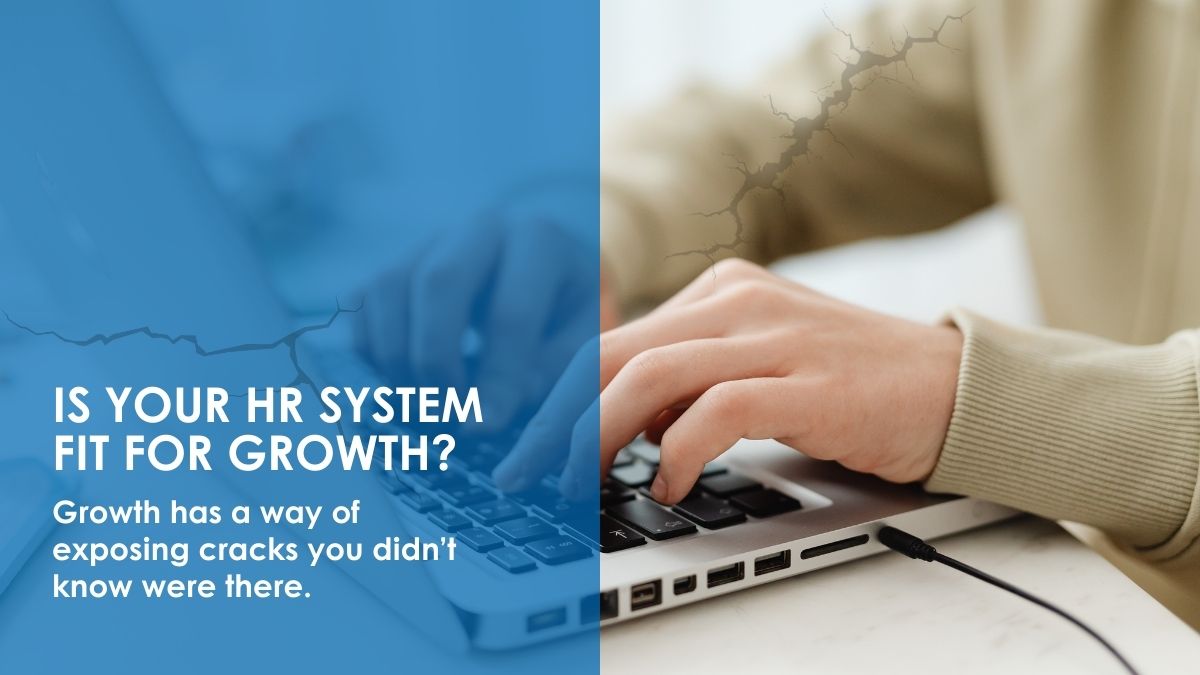
Growth has a habit of flattering organisations into thinking everything is working.
Revenue is rising, headcount is expanding, and new opportunities are opening up faster than leadership teams can track them. In that environment, operational strain is easy to overlook — especially when teams are working hard to “keep things moving”. Yet for many fast-growing organisations, the first real cracks in scalability don’t appear in sales or delivery. They appear quietly, behind the scenes, in the HR system that once felt more than adequate.
Outgrowing an HRIS is rarely dramatic. There is no single failure point or catastrophic moment. Instead, capability erodes slowly, hidden behind workarounds, manual fixes and well-intentioned heroics from HR and payroll teams. Leader’s sense something is off, but because nothing has formally broken, the issue remains comfortably deferred. Until it can’t be.
The subtle signs an organisation is outgrowing its HRIS
Most organisations don’t recognise they have outgrown their HR system because the symptoms rarely present as “system failure”. Instead, they show up as small, rationalised compromises — decisions made in the name of speed, pragmatism or short-term efficiency. Over time, these compromises become embedded, and what started as a sensible adaptation turns into structural drag.
HR teams begin to maintain parallel spreadsheets “just in case”. Payroll reconciliations quietly extend into evenings or weekends. Reporting packs require more explanation than confidence. Managers express frustration in passing, while employees disengage from self-service tools without making a fuss. None of this feels urgent. But together, these signals indicate that the system is no longer scaling at the same pace as the organisation.
A particularly telling moment is when process design is dictated by system limitations rather than business needs. When workflows exist because “that’s how the system works”, the organisation has already outgrown its HRIS — whether it realises it or not.
When HR systems lag, the cost shows up elsewhere
When an HRIS starts to fall behind organisational growth, the consequences rarely stay contained within HR. Instead, the cost surfaces gradually across the business, often in places leaders do not immediately associate with HR technology. What appears to be inefficiency or frustration often has a deeper, systemic cause.
For HR teams, system limitations translate into disproportionate administrative effort. Time that should be spent on workforce planning, leadership development and organisational design is absorbed by data correction, workaround creation and exception handling. Growth creates more demand for strategic HR input — precisely when the system makes that input harder to deliver.
For payroll and finance, the risk profile changes. Misaligned systems increase the likelihood of errors, weaken audit trails and reduce resilience at critical points such as month-end or year-end. Confidence in workforce cost data erodes — often at the very moment leadership needs sharper insight to support investment or acquisition decisions.
For employees and managers, the experience subtly deteriorates. Delays become normalised. Errors undermine trust. What once felt like a well-run, agile organisation begins to feel bureaucratic, despite everyone’s best intentions. At scale, these issues affect not just efficiency, but credibility.
Why growth exposes HR system weaknesses
Growth itself is rarely the root cause of HR system pain. Complexity is. As organisations scale, they introduce new layers of structure, governance and expectation — and those layers place demands on systems that were never designed to support them.
Rapid growth often brings multiple entities, new locations, varied employment terms and more demanding reporting requirements. Regulatory exposure increases. Leadership expectations shift from “what happened” to “what’s happening now”. Systems that performed well in simpler environments struggle to keep up when organisational shape changes faster than system architecture.
The danger lies in misattribution. Leaders frequently assume these issues are simply “part of growing up”, rather than recognising that growth is exposing limitations that were always present. In reality, the system hasn’t failed — it has simply reached the edge of what it was designed to do.
Replace, reconfigure or integrate? Asking the right question
When frustration builds, the default response is often to assume replacement is inevitable. New software feels like progress, and vendor conversations can be reassuringly confident. But replacing an HRIS without understanding the underlying problem often creates new challenges rather than solving old ones.
In practice, there are three strategic paths available — and choosing between them requires judgement, not urgency. Some organisations need to reconfigure systems that were implemented for a different stage of growth. Others need to integrate, allowing specialist platforms to handle complexity while retaining a stable core. Replacement should be reserved for situations where architectural limits genuinely prevent future scalability.
The mistake is not choosing the “wrong” option — it is choosing any option reactively, under pressure, without a clear view of what the organisation is becoming.
Why timing matters more than technology
The most underestimated factor in HR system change is timing. Technology decisions made too late are almost always more expensive, more disruptive and more politically charged than those made early.
When organisations delay, they accumulate manual work, degrade data quality and entrench workarounds into daily operations. By the time change becomes unavoidable, options are limited and tolerance for disruption is low. What could have been a controlled evolution becomes a forced transition.
Acting early does not mean rushing to replace systems. It means creating optionality — the ability to improve, integrate or transition on your own terms. That is a leadership decision, not a technical one.
Building a scalable HRIS roadmap that supports growth
Organisations that navigate HRIS evolution successfully share one common discipline: they separate assessment from solution. Rather than starting with vendors or features, they start with clarity about where they are and where they are going.
This means taking a hard look at current capabilities, future growth scenarios, and non-negotiable requirements around accuracy, automation, and resilience. It also means aligning HR, payroll, finance and IT early, rather than treating HR systems as an isolated function.
A phased, intentional roadmap allows HR technology to evolve alongside the organisation — supporting growth rather than reacting to it. In that context, HRIS becomes an enabler of scale, not a brake on it.
A final thought for leaders
Outgrowing an HR system is not a failure. In many cases, it is a sign that the organisation is succeeding faster than its infrastructure anticipated.
The real risk lies in ignoring early signals, relying on goodwill and workarounds, and postponing decisions until the cost of inaction outweighs the discomfort of change. Growth stretches organisations. The question is whether your HR infrastructure stretches with it — or quietly holds it back.
How Tugela People can help
At Tugela People, our HR consulting and HR system selection services help organisations ensure their HRIS keeps pace with growth. We work with leaders to step back from daily frustrations and take a clear, structured view of their current HR system, future growth plans, and the options available — whether that means optimising existing systems, integrating additional solutions, or selecting a new HRIS with confidence.
If your HR system is starting to feel slightly behind, an early, independent assessment can create clarity, protect your options, and ensure your HR technology supports the organisation you’re becoming — not the one you’ve already outgrown.
Your Questions Answered
[FAQ]
-
How do I know if we’ve outgrown our HR system?
Most organisations outgrow their HR system gradually rather than through a single failure. Common signs include increased reliance on spreadsheets and manual payroll checks, inconsistent or slow reporting, and processes shaped by system limitations rather than business needs. If HR and payroll teams are spending more time maintaining workarounds than delivering value, the system may no longer be fit for scale.
-
Is it normal for HR systems to struggle as organisations grow?
Yes. As mid-sized organisations grow, complexity increases — through new entities, locations, employment terms and reporting requirements. Many HR systems are designed for simpler structures and struggle when organisational shape changes faster than the system’s capabilities.
-
Does outgrowing an HRIS mean we need to replace it?
Not necessarily. Replacement is only one option. In many cases, systems can be reconfigured, extended or integrated to support growth. The right approach depends on understanding whether the issue is configuration, architecture or future scalability — not reacting to frustration alone.
-
What are the risks of delaying HR system decisions?
Delaying action often increases cost and disruption. Manual workarounds become embedded, data quality degrades, and tolerance for change decreases. When a system change becomes unavoidable, organisations are more likely to make rushed decisions with limited options.
-
When is the right time to review our HR system?
The right time is when early warning signs appear — not when failure occurs. Reviewing your HR system early does not commit you to change. It allows organisations to plan improvements, integrations or transitions on their own terms.
-
Who should be involved in HR system decisions?
HR system decisions should involve HR, payroll, finance and IT. Early cross-functional alignment improves data integrity, compliance, reporting confidence and long-term scalability, reducing risk later in the lifecycle.
-
What does a scalable HRIS roadmap look like?
A scalable HRIS roadmap starts with understanding current capability and future growth scenarios before selecting technology. It typically includes phased improvements, clear priorities and alignment between people, process and systems, allowing HR technology to evolve alongside the organisation.
-
How can HR consulting help with HR system selection?
HR consulting provides an independent assessment before any technology decision is made. It helps organisations clarify requirements, evaluate realistic options and avoid reactive or vendor-led choices — whether the outcome is optimisation, integration or system selection.
-
When should leaders seek external HR system expertise?
External support is valuable when internal teams sense the HR system is under strain but lack the time or objectivity to assess it fully. If HR system concerns recur without resolution, a structured, independent review can provide clarity.